Blind Spot Truck Accidents in Chicago, IL
Last Updated on August 18, 2026 by Patrick A. Salvi II
Chicago is one of the busiest places in the country. In fact, it is the third-most populous city in the United States, with a population of just over 2.7 million. In order to support industry in the city and meet consumer demand, large trucks are spotted traveling through Chicago on a daily basis, delivering various goods and materials.
While large trucks are essential, they can also be dangerous. Even when a truck driver is operating the vehicle responsibly, a truck accident is possible. One of the most common types of large truck accidents ─ and one of the most serious ─ is a blind spot truck accident.
If you or a loved one has been hurt in a blind spot truck accident in Illinois, our Chicago truck accident lawyers at Salvi, Schostok & Pritchard P.C. can help you to understand your legal rights.
Get help from the nearest truck accident attorney in Chicago
What Is a Blind Spot (No-Zone) Truck Accident?
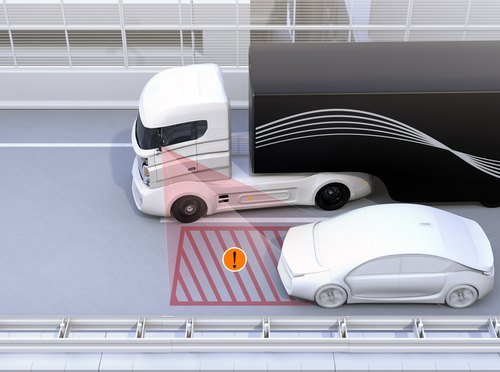
A large truck’s blind spots are officially called “No-Zones,” a term used by the Federal Motor Carrier Safety Administration (FMCSA) to describe the areas around a commercial vehicle where the driver cannot see other road users. These No-Zones exist at the front of the truck, at the rear, and along both sides, with the right-side No-Zone being the largest and the most dangerous for the motorists caught within it.
A blind spot accident refers to a type of accident that occurs because the driver of one vehicle simply did not see the other vehicle (or pedestrian, cyclist, or motorcyclist), thereby running over, backing up into, running off the road, or side-swiping the other party. These crashes occur because the victim was within the driver’s “blind spot,” which refers to an area around a vehicle that cannot be directly observed by the driver during operation.
All vehicles have blind spots, but the blind spots on big trucks are especially large. For example, blind spot accident statistics noted by Consumer Reports reveal that while the average-height driver of a passenger car may have a rear blind spot of about 12 feet, a pickup truck driver will face a rear blind spot distance of about 24 feet.
Large trucks’ blind spots, referred to as “no zones” by the Federal Motor Carrier Safety Administration (FMCSA), are even bigger: 30 feet directly behind a large truck, two lanes to the right of a large truck, one lane to the left of the truck, and 20 feet directly in front of the large truck. This large area of impaired visibility poses a serious danger to those caught within it.
Common Causes of Blind Spot Collisions
A blind spot collision can happen for a variety of reasons, but the most common cause is simply that the driver of a large truck did not see the smaller vehicle within its blind spots, and therefore adjusted the truck in a way that impacted the smaller vehicle. This may result from:
- A passenger car tailgating or being tailgated by a large truck
- A truck driver’s aggression ─ i.e. tapping the truck’s brakes to get a driver to back off
- During a routine lane change, where the truck driver simply does not see the driver in his or her blind spot
- A passenger car “hanging out” in a large truck’s blind spots
Blind spot accidents are usually completely preventable. For truck drivers, it is important to know how to check blind spots while driving to ensure the safety of smaller cars around them. Because a truck’s largest No-Zone runs along its right side, blind spot collisions frequently overlap with wide-turn truck accidents, in which a driver swings left before turning right and traps a smaller vehicle alongside the trailer. Similar visibility and maneuvering risks can arise in other specialized truck crashes, including those involving snowplows. If you were injured in one, a Chicago snowplow accident lawyer can investigate the circumstances of the collision.
Safety Tips When Driving Around Large Trucks
Although you cannot control other drivers on the road, there are some safety precautions you can take to protect yourself when driving near a large truck. Some of the best ways that you can avoid a blind spot truck accident as a driver of a passenger car include:
- Give large trucks plenty of room when you are changing lanes in front of them.
- Use your blinkers to let a truck driver know what you’re going to do.
- Never spend too much time in a truck driver’s blind spot ─ if you need to pass, do so quickly.
- Never pass a large truck on the right, where blind spots are larger and a truck driver is less likely to expect you.
- Never tailgate or engage in other aggressive behaviors around a large truck.
Injuries from a Blind Spot Accident
Failure to see another driver may result in a side-swipe accident, an over-ride or under-ride crash, or a passenger car being run off the road by the larger vehicle. In any case, the injuries that result could be very severe, and a driver or occupant of a passenger car may be left with serious medical problems in the form of:
- Traumatic brain injury
- Limb crush or amputation injury
- Back or neck injury
- Spinal cord injury
- Internal injuries
- Bone fractures
- Facial injuries
These injuries are costly, painful, and can leave a victim with long-term health issues. Our knowledgeable Illinois truck accident attorneys help crash victims demand full and fair compensation for both current and future damages.
Who Is at Fault in a Blind Spot Truck Accident?
Determining who is at fault for a blind spot accident can be complicated. It is impossible to determine fault in truck accidents caused by blind spots without a comprehensive investigation. In many cases, a truck driver’s failure to look is the cause. In some instances, though, there may be other at-fault parties.
Proving fault in a blind spot truck accident depends on physical evidence that shows what the truck driver could see and how the vehicles were positioned at the moment of impact. Our attorneys move quickly to preserve the truck’s engine control module, or “black box,” along with electronic logging device (ELD) records and driver logs that document hours of service and driver behavior. Dashcam footage, the truck’s mirror settings, and the final resting positions of both vehicles help establish whether the driver failed to check a No-Zone before changing lanes or turning. When necessary, we retain accident reconstruction experts to demonstrate how the collision occurred and why the driver or trucking company is responsible.
Our blind spot attorneys will investigate your accident to get to the bottom of what happened and determine who should be held accountable.
What to Do Immediately After a Blind Spot Accident
Immediately after a blind spot accident, you need to:
- Seek medical care.
- Report the accident to the police and your insurer.
- Get the truck driver’s name, the name of his or her employer, insurance information, and contact information.
- Gather any evidence you can such as photos of the crash scene and your injuries.
- Write down the names and contact information for any witnesses.
Call our offices for immediate help after any truck accident. Our dedicated attorneys will launch an investigation into your crash right away and begin documenting the ways in which your injuries have affected you.
Frequently Asked Questions
What kind of attorney handles blind spot truck accidents?
Blind spot truck accidents are handled by a personal injury attorney who concentrates on truck accident cases and understands the federal and state regulations that govern commercial carriers. These cases are more complex than ordinary car accidents because they often involve Federal Motor Carrier Safety Administration (FMCSA) rules, electronic logging data, and multiple potentially liable parties. At Salvi, Schostok & Pritchard P.C., our Chicago truck accident lawyers have handled serious trucking claims throughout Illinois for more than 40 years.
How can I hire a lawyer for a blind spot truck accident?
You can hire a lawyer for a blind spot truck accident by contacting a firm that offers a free consultation, during which an attorney will review the facts of your crash and explain your options at no cost. Most personal injury truck lawyers, including our firm, work on a contingency-fee basis, so you pay no upfront fee and the attorney receives a percentage of any recovery only if your case is successful. Because Illinois generally allows two years from the date of injury to file a personal injury claim, it is important to speak with a lawyer promptly so that critical evidence can be preserved.
How do you prove a truck’s blind spot caused your crash?
Proving that a truck’s blind spot, or No-Zone, caused a crash begins with preserving evidence from the truck itself, including the engine control module, or “black box,” the electronic logging device, and the driver’s logs. Attorneys also examine dashcam footage, the truck’s mirror adjustment, and the positions of the vehicles after impact to show that the driver failed to see or yield to a vehicle traveling in a No-Zone. In many cases, an accident reconstruction expert is retained to recreate the sequence of events and confirm how the collision happened.
What causes blind spot truck accidents?
Blind spot truck accidents are most often caused by a truck driver who changes lanes, merges, or turns without seeing a smaller vehicle traveling within one of the truck’s No-Zones. Contributing factors include a failure to check mirrors or signal, improperly adjusted mirrors, tailgating, and aggressive driving near passenger cars. These crashes are frequently preventable, and when a truck driver or trucking company fails to account for a known No-Zone, they may be held liable for the resulting injuries.
How Our Law Firm Can Help After a Blind Spot Truck Accident
A blind spot truck accident should be handled by a truck accident attorney or personal injury lawyer who understands the FMCSA regulations and commercial-trucking rules that govern large carriers. At Salvi, Schostok & Pritchard P.C., our Chicago truck accident lawyers have investigated catastrophic trucking crashes throughout Illinois for more than 40 years, and we know how to identify every liable party, from the driver to the motor carrier. Hiring our firm is straightforward, because we work on a contingency-fee basis, which means you pay no upfront fee and our fee is a percentage of any recovery we obtain for you. We encourage injured victims and their families to reach out for a free consultation before speaking with an insurance adjuster or accepting any settlement.
Our trucking results include a $67 million truck-crash verdict in a case involving a Panera truck, a result that reflects the resources and determination we bring to every blind spot truck accident we handle.
Our respected Illinois personal injury lawyers are passionate about helping crash victims pursue the compensation that they need after a serious blind spot truck collision. For your free consultation, please contact our blind spot truck accident lawyers at Salvi, Schostok & Pritchard P.C. directly. We are here to help.